
Traffic accommodation plans, drafted to the manual.
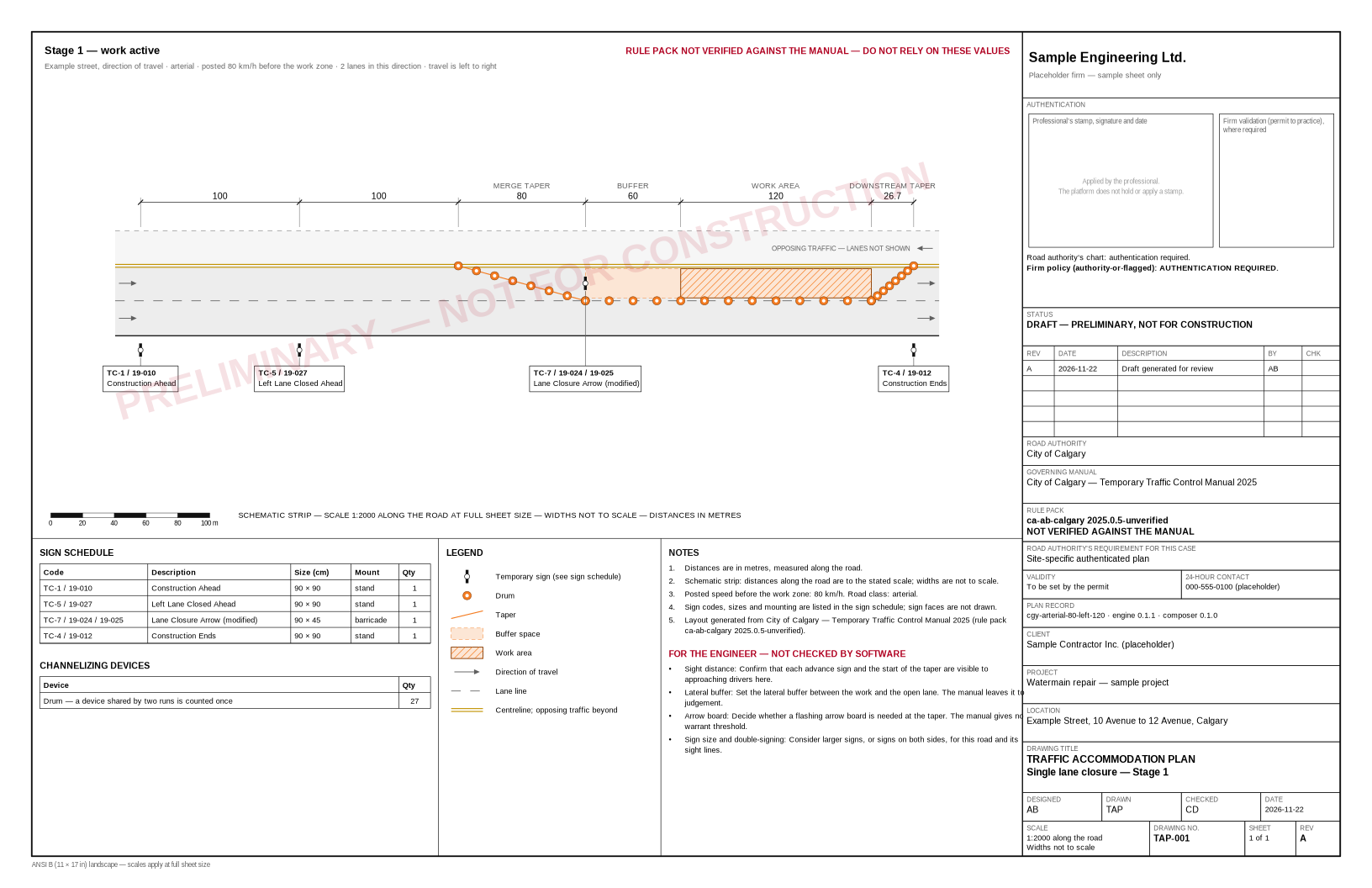
TAP.Engineer drafts a traffic accommodation plan from the facts of the work, cites every dimension to the page of the manual it came from, and hands you a sheet to review, edit and authenticate.
Tuned for Alberta's roads. Built on the national manuals, so the same method carries across North America.
Every value has a page number
For each plan the engine lists what it derived, the rule that produced it and the page it rests on. Nothing on the sheet is a number without a source.
This is its output for a Calgary collector at 50 km/h, right lane closed, 40 m of work.
| Derived value | Value | Page |
|---|---|---|
| Merge taper length | 30 m | p. 28 |
| Downstream taper length | 10 m | p. 26 |
| Buffer length | 35 m | p. 28 |
| Advance sign spacing | 50 m | p. 28 |
| Device spacing, at most | 8 m | p. 28 |
| Devices on each taper, at least | 5 | p. 28 |
| Channelizing device | cone | p. 40 |
| Sign size class | regular | p. 30 |
Sample output. The Calgary rule pack is version 2025.0.5 and its tables are not yet verified against the manual. A licensed professional engineer verifies every pack before it is released.
How it works
-
Describe the work
Road, posted speed, side, length of the work and road class. Driveways and other site features where they matter.
-
Drafted by rule
Signs, tapers, buffer, devices and their spacing come from the jurisdiction's pack: the manual's own tables, each with its page.
-
Checked twice
A separately written validator checks the layout against the rules. Drawing QA checks the sheet against the plan.
-
Edit on the canvas
Move the work area or a sign and the rules place everything again. What you move by hand stays put, and a deviation is recorded with its reason.
-
Issued for your seal
An 11 × 17 vector PDF with the strip drawing, sign schedule, device quantities and notes. The authentication box is left for you.
Tuned for Alberta
Release 1 drafts plans for Calgary, Edmonton and Alberta's provincial highways. The manuals of Alberta's other major cities have been read into the knowledge base page by page, so their packs follow.
- Drafting today
- Manual read, pack next
- Follows the provincial manual
- Provincial highways
| Road authority | Manual | Status |
|---|---|---|
| Alberta Transportation and Economic Corridors provincial highways | Traffic Accommodation in Work Zones, 2nd edition, 2025 | Drafting |
| City of Calgary | Temporary Traffic Control Manual, 2025 | Drafting |
| City of Edmonton | Manual of Temporary Traffic Control, 2023 | Drafting |
| City of Red Deer | Temporary Traffic Control Manual, September 2025 | Manual read |
| City of Lethbridge | Temporary Traffic Control Manual | Manual read |
| Regional Municipality of Wood Buffalo Fort McMurray | Utility Installation and Traffic Control Manual, 2012 | Manual read |
| City of Grande Prairie | No manual of its own: the City's excavation guidance points to the provincial manual | Provincial manual |
| Also read in full | Medicine Hat, St. Albert, Strathcona County, Strathmore, Parkland County | Manual read |
The knowledge base holds 120 documents and 4,228 provisions, each tied to the page it came from. A manual read is not a pack: a pack's tables are encoded, tested and verified by a licensed professional engineer before it drafts.
Tuned for Alberta, built for North America
Every plan rests on a national manual: Canada's Manual of Uniform Traffic Control Devices and the United States MUTCD, 11th Edition. A road authority's own rules sit on top as a pack, with its manual's tables, its permit terms and its sign codes.
Because the method is the same everywhere, most North American traffic accommodation work can be drafted this way once the local pack is in place.
- Now
- Alberta: Calgary, Edmonton, provincial highways
- Next
- Red Deer, Lethbridge, Wood Buffalo and other Alberta cities
- Then
- British Columbia and Vancouver, Ontario and Toronto
- After
- US states on the MUTCD base
The seal stays yours
The software never applies a seal. Every sheet leaves the authentication box empty and lists what the software did not check, so your review starts where the rules stop.
- Sight distance. That each advance sign and the start of the taper can be seen by approaching drivers.
- Lateral buffer. The clearance between the work and the open lane.
- Arrow board. Whether a flashing arrow board is needed at the taper.
- Sign size and double-signing. Larger signs, or signs on both sides, for the road and its sight lines.
Request early access
TAP.Engineer is in development and opening first to Alberta engineering firms and traffic accommodation designers. Tell us the roads you plan on and the kind of work you accommodate.
Write to